I'd Never Really Seen It Until I Stood Inside It
A surgical resident on the impossible task of building a true 3D mental model of the body from flat images — until immersion let them step inside the anatomy itself.
I had memorised the anatomy. I had not, until I stood inside it, ever truly *seen* it.
This is the quiet problem with learning anatomy from books and even from cadavers: the body is profoundly three-dimensional — layered, nested, spatially intricate — and you're trying to build a true 3D mental model of it from flat images and limited dissection. I could label every structure on a diagram. I could recite the relationships. But when it came to actually understanding how everything sat together in space — how this vessel ran behind that organ, how the layers nested, what I'd actually encounter and in what order — my mental model was patchy and flat, assembled from two-dimensional fragments. For a surgeon, that spatial understanding isn't academic. It's the whole game. You operate in three dimensions; a flat understanding is dangerous.
The hepatobiliary region nearly broke me. The relationships there are complex and spatial, and no diagram ever made them click. I knew the names. I didn't have the *picture* — the real, three-dimensional, walk-around-it picture you need to operate with confidence.
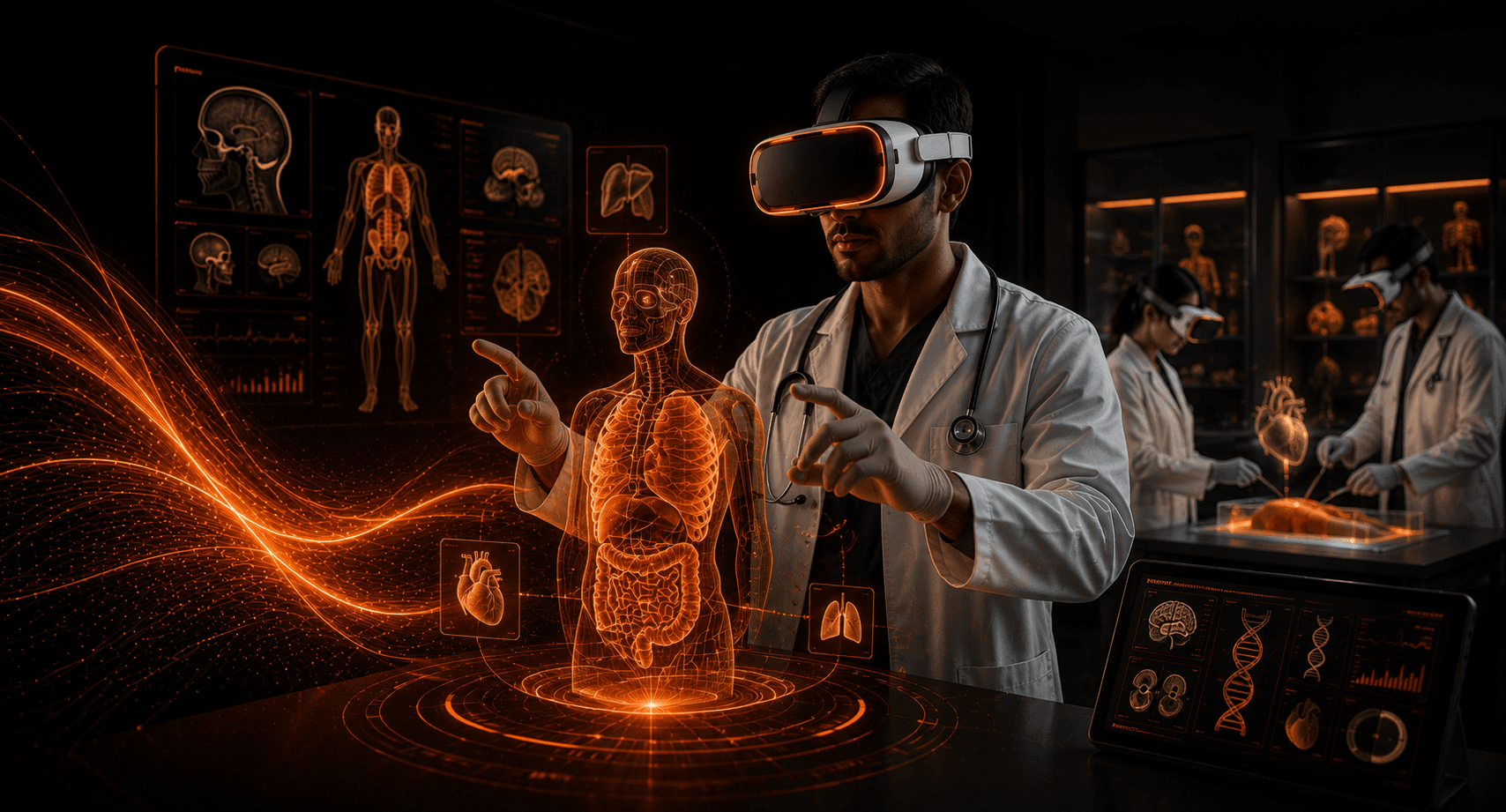
Immersive visualisation let me step inside the anatomy and finally see it as the spatial thing it is.
I didn't look at a diagram of the region. I stood within it, at scale, and walked through the actual three-dimensional relationships — saw how the structures truly sit together, behind and around and through each other, in a way no flat image had ever conveyed. The thing I'd been failing to assemble in my head from fragments was suddenly just *there*, complete, spatial, explorable. I could move around it, see it from the angle I'd actually approach it from in surgery, understand the relationships not as memorised facts but as a place I'd been.
The hepatobiliary anatomy that had defeated every diagram clicked in an afternoon — because I finally saw it as the 3D reality it is, instead of trying to reconstruct three dimensions from two.
My mental model is solid now, and it's solid in the right way: spatial, three-dimensional, the way I'll actually meet it in the operating room. When I picture the anatomy now, I don't recall a diagram. I recall a space I've stood inside.
You cannot build a three-dimensional surgeon's understanding from two-dimensional pictures. I tried for years. I needed to stand inside the body to finally see it.
Want to see immersive training running in your industry?
Book a Demo →